
Latest Posts
Murals in Menomonie
Becoming a WallDog: Four Days, Fifteen Murals, One Incredible Community
This summer, we had a brush with history, and traveled with friend and fellow painter, Pamela Bliss, to the “WallDogs Murals in Menominee” festival in Menominee, Wisconsin. Two hundred artists from across the United States and beyond came together with one ambitious goal: transform an entire community through public art.
In just four days, the WallDogs completed fifteen large-scale murals throughout the city.
If you’ve never heard of the WallDogs, they are an international organization of sign painters, muralists, illustrators, and decorative artists who volunteer their talents to create historically inspired murals that celebrate the heritage of communities across America. The pace is intense, the days are long, and the logistics are astonishing.
Watching dozens of artists coordinate scaffolding, lifts, grids, paint, lettering, illustration, and finishing touches on multiple murals simultaneously was inspiring. Every mural represented hundreds of hours of planning before the first brush ever touched a wall.
What impressed me most was not only the murals, but the wide age range of participants—from teens to octogenarians—all collaborating for the love of painting.
Experienced artists shared techniques, solved problems together, and encouraged one another from start to finish. There was little ego and a strong sense of teamwork. It reminded me why I fell in love with creating art in the first place.
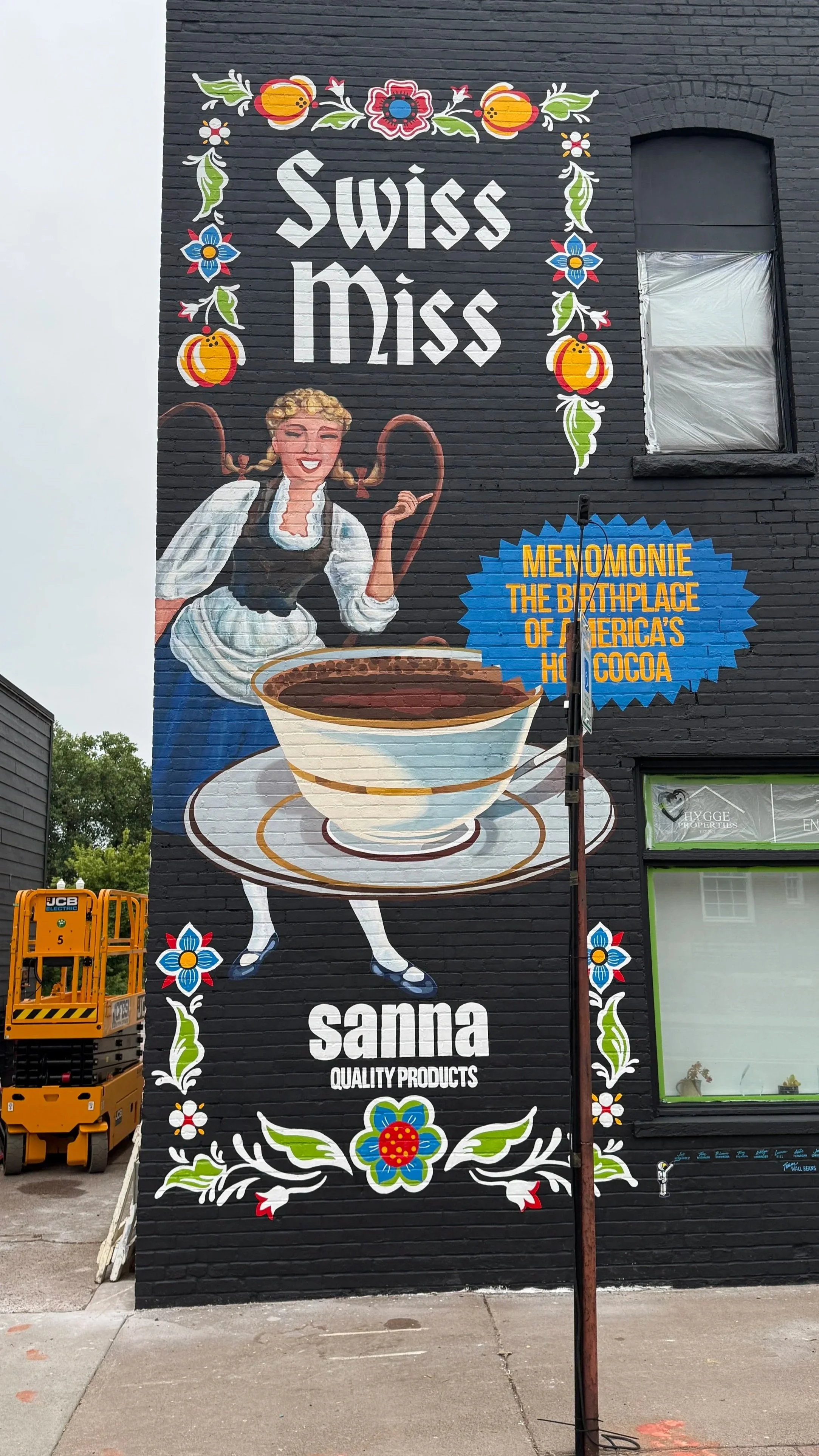
I painted alongside Pamela Bliss and a talented group of ten artists led by Joy Hernandez. We were Team “Swiss Miss.” The instant hot cocoa drink known as Swiss Miss was invented—and is still produced—in Menominee. Our mural recreated an early print ad: a black background with Swiss flowers, a Swiss maiden, and a beautifully rendered cup and saucer filled with hot cocoa.
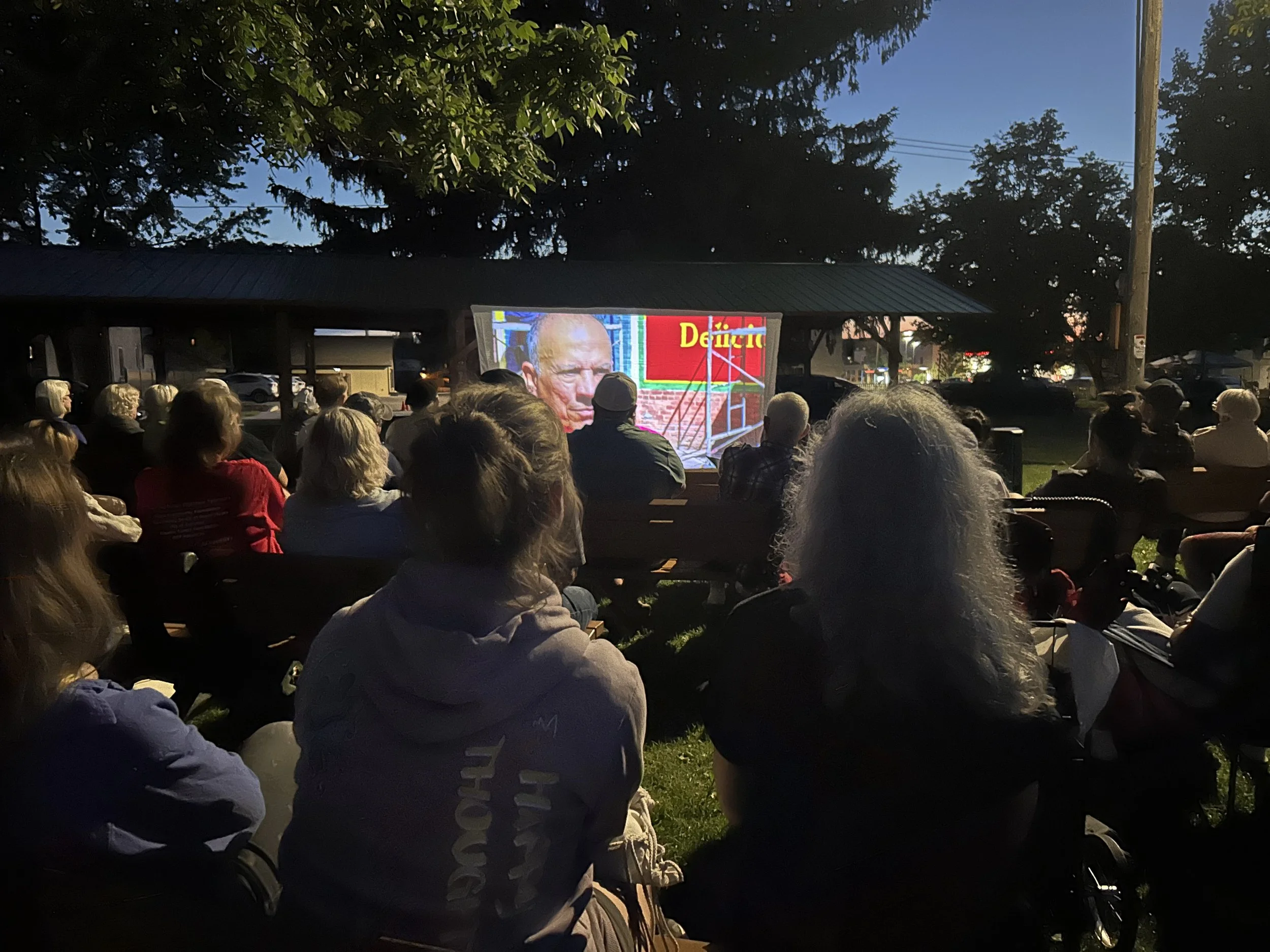
Joy Hernandez not only led our team, she also debuted her documentary, “WallDog Daze,” during the festival! This girl can multitask!
The screening took place in the Menominee town park on a perfect summer evening, with the distant buzz of dirt track races from the fairgrounds just down the street. Projected on a bedsheet movie screen for a park full of WallDogs, the film brought their story—and their community—to life. It shared how the tragedy of losing a family farm grew into a lasting tradition and a united network of artists.
Throughout my career with Blice Edwards Decorative Painting & Murals, much of my work has been done independently or with a small team. Being part of a much larger group working toward a common goal was energizing. Each evening, you could walk through town and watch the transformation unfold block by block.
By the end of the festival, fifteen new murals had become lasting gifts to the community—works of art that tell local stories for generations to enjoy.
Joining the WallDogs is more than a milestone—it’s becoming part of a tradition. A community of artists who believe public art can strengthen communities, preserve history, and create places people are proud to call home.
We are grateful to everyone who organized the event, welcomed me into the group, and worked beside us during those unforgettable four days.
The Return of Interior Murals
A shift away from minimalism toward color, atmosphere, and story
For much of the past decade, interior design leaned heavily toward minimalism. White walls,
monochromatic palettes, industrial materials, and stripped-down spaces became common in homes,
restaurants, and commercial interiors. While the aesthetic offered calm and simplicity, many spaces
began to feel somewhat anonymous.
Recently, a subtle shift has begun to take hold. Designers and homeowners are reintroducing color,
warmth, and character into interior spaces. Earth tones, layered neutrals, muted blues, and warmer
palettes are replacing stark whites and grays. Texture and handmade elements are finding their way
back into the conversation.
Murals as an Alternative to Blank Walls
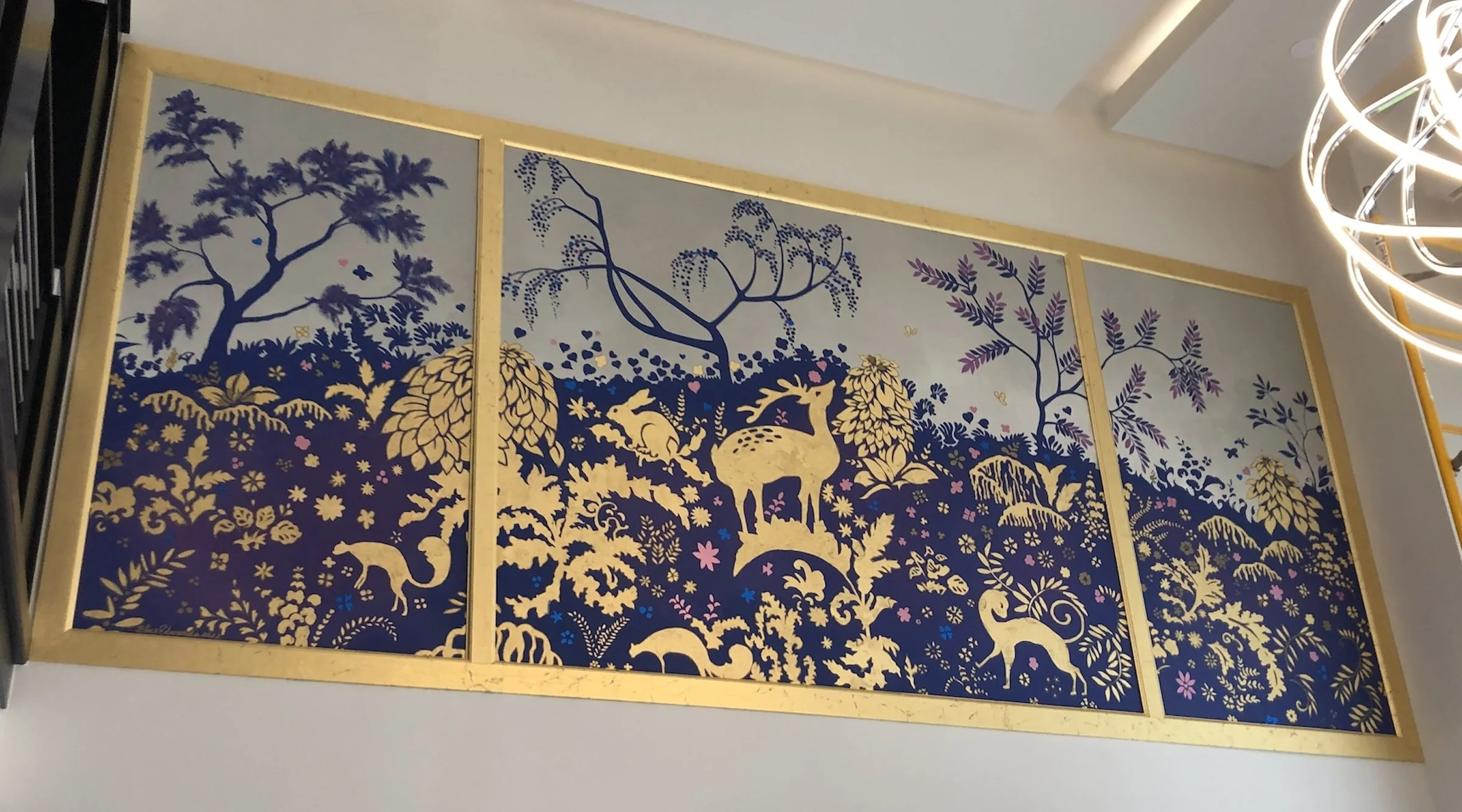
Murals offer something traditional decoration cannot. Rather than simply covering a wall with color, a
mural can introduce atmosphere, movement, or a sense of place. It might suggest landscape, rhythm,
typography, or symbolic imagery that subtly changes how a room is experienced.
Warmer Color Palettes in Interior Design
Designers are also moving away from stark monochromatic schemes toward warmer, more organic
palettes. Colors inspired by nature—soft greens, clay tones, ochres, and deep blues—create depth and
atmosphere while still maintaining a calm environment. These tones work beautifully with murals
because they allow imagery to integrate naturally with the architecture of the room.
A Personal Perspective
After more than three decades working in decorative arts and mural painting, I’ve seen design trends
come and go. What remains constant is the impact a thoughtfully designed mural can have on a space.
Some murals are bold and graphic, while others are quiet and atmospheric—meant to influence how a
room feels rather than immediately announce themselves.
If you’ve been thinking about bringing more color, atmosphere, or a sense of place into an interior
space, a mural can be a powerful way to transform a wall. Feel free to reach out through the contact
page if you’d like to explore
Commission an Original Landscape Painting of Your Hometown — Here's Why It's Worth It
There's something about a place that shapes you. The street you grew up on. The skyline you've watched from a distance your whole life. The park where your kids have spent their summers. Indianapolis is full of those kinds of places — and if you've ever thought about capturing one of them in a painting that's entirely your own, you're not alone.
Commissioning an original landscape painting of your hometown is one of the most meaningful ways to preserve a connection to place. Not a print, not a photo filter, not a stock image — a real, handcrafted work of art built around a location that actually matters to you.
Why a Custom Landscape Painting Beats Any Other Option
Photography is wonderful. But a photograph captures a moment. A painting captures a feeling. When an artist takes the time to study a scene — its light, its texture, its emotional weight — the result isn't just a reproduction. It's an interpretation. You end up with something that feels more true to the place than a camera ever could.
That's especially the case with mixed media work, where the layering of materials adds depth and dimension that a single medium simply can't replicate. A mixed media landscape can carry the roughness of a brick facade, the shimmer of the White River at dusk, or the quiet weight of a neighborhood street in a way that feels alive on the wall.
Custom landscape commissions also make genuinely thoughtful gifts — for a homecoming, a milestone birthday, a wedding, a retirement, or simply as a piece of art you've always wanted to own. Unlike most gifts, they don't fade in relevance. A painting of a place someone loves will mean as much in twenty years as it does the day it's unwrapped.
What Makes BliceEdwards.com the Right Studio for This Project
Based in Indianapolis, Indiana, BliceEdwards.com brings a local perspective to every commission. That matters more than it might seem. An artist who knows Indianapolis — who understands the particular quality of light over the Monument Circle at golden hour, or what the neighborhoods just outside downtown actually look like — brings that knowledge into the work. You're not describing a place to someone who has to look it up. You're collaborating with someone who gets it.
The studio specializes in mixed media painting, which is particularly well-suited for landscape commissions. Mixed media allows for a layered, textured approach that brings more visual complexity to a scene than traditional single-medium work. The result is a painting with presence — something that rewards a long look and holds up over time.
The commission process is built around collaboration. From the initial conversation about your vision to the selection of source material and the finished piece, you're part of the process. This isn't a situation where you hand over a photo and wait. It's a dialogue — one that ensures the final painting reflects what you actually want.
What to Expect When You Commission a Landscape Painting
If you've never commissioned original artwork before, here's a straightforward picture of how it typically works:
You start by sharing your vision — the location, the mood you're after, any reference photos you have, and the intended use (a gift, a focal piece for your home, a memorial to a place that no longer exists). From there, the artist will discuss dimensions, medium, and timeline. You'll have the opportunity to give input and feedback as the work develops.
Pricing for custom landscape commissions varies based on size and complexity, but the investment reflects what you're actually getting: an original, one-of-a-kind work of art that no one else in the world owns. That's a different category than anything you'll find in a retail store or on a mass-market art platform.
Indianapolis Has More Stories Worth Painting Than Most People Realize
The city has a genuinely rich visual landscape — from the architecture of the historic Meridian-Kessler neighborhood to the industrial character of Fountain Square, from the open spaces of Eagle Creek Park to the energy of Mass Ave. If you've lived here any length of time, you have a place in this city that means something to you. A landscape commission is a way of honoring that.
It's also worth noting that commissioned paintings of Indianapolis locations make an exceptional gift for anyone who has moved away from the city. There's a particular kind of longing that comes with leaving a place you love, and a well-executed painting of a meaningful location speaks directly to that.
Ready to Start?
If you're thinking about commissioning an original landscape painting of Indianapolis or any hometown that matters to you, BliceEdwards.com is the place to start the conversation. Reach out directly through the website to discuss your project — what you have in mind, the timeline you're working with, and what you'd like the finished piece to say.
The best commissions start with a clear vision and the right artist. Both of those things are within reach.
Hand-Painted Art Relevance in the AI Era: Importance, Challenges & Opportunities
Written by an artist who believes the world still needs the human hand — now more than ever.
I Want You to See What I See
I've been painting for over two decades. I've mixed colors until my hands were stained for days. I've scraped down canvases I hated and started over at midnight. I've sat in front of a blank linen panel for an hour doing nothing but looking — really looking — before I dared make a single mark.
So when AI image generators arrived and people started whispering that artists like me were becoming irrelevant, I didn't panic. I got curious. I tried the tools. I watched them produce glossy, technically impressive images in seconds. And then I felt something I didn't expect: not fear, but clarity.
Because what I saw in those generated images — beautiful as some of them were — was the one thing they could never have. A human being was not present in their making.
That's what I want to talk to you about. Not as a warning, and not as a rant. As an invitation to look more closely at what hand-made art actually is — and why I believe it matters more today than it ever has before.
What a Painting Actually Is
People often look at a finished painting and see the result. What they don't see — what I wish I could show every person who stands in front of my work — is everything that went into it before the final brushstroke.
Every painting I make is a record of a living process. It holds the decision I made at 9 in the morning when the light was hitting my reference a certain way and I chose to exaggerate the warmth. It holds the moment I nearly ruined it and then, somehow, saved it with a scrape of a palette knife. It holds my frustration, my focus, my sudden delight when something clicked. All of that is embedded in the paint itself — in the texture, the layering, the small imperfections that make the surface alive.
When you stand close to a hand-painted canvas, you are standing close to a record of another person's full attention. Their time. Their choices. Their presence.
An AI doesn't experience light on water. It doesn't remember a childhood smell that makes a certain yellow feel melancholy. It has never failed at something and tried again. It generates images by recognizing patterns in data. What it produces can look extraordinary — but it was never lived. And I believe that difference, even if a viewer can't put words to it, is something they feel in their body when they stand in front of real paint.
The Things That Cannot Be Generated
I want to be specific about this, because I think it matters.
A painting has a physical life. It exists in three dimensions. The paint has thickness. The canvas has grain. When the light in a room shifts, the painting changes with it. My work looks different in morning sun than it does under a lamp at night — and that's not a flaw, that's part of what it is. No printed file, no screen, no AI output can offer that. A painting occupies the same physical world you do, and it responds to it.
A painting is singular. There is exactly one of it in the world. When someone takes one of my paintings home, they are taking something that cannot be duplicated — something that carries a history and a specificity that a generated image, which can be reproduced infinitely and identically, simply does not have. This is the foundation of why people collect original art, and it is not going to change.
A painting carries a point of view. When I make compositional choices, choose a palette, decide what to leave ambiguous and what to render with precision — those choices come from somewhere. From years of looking. From things I believe about beauty and tension and light. From the specific person I am, shaped by the specific life I've lived. AI has access to patterns. I have a perspective. Those are not the same thing, and a viewer who cares about meaning — who wants to understand why something was made, not just admire how it looks — will always find more to engage with in hand-made work.
Imperfection is honest. I know artists who apologize for the wobble in a line or the uneven edge of a glaze. I want to ask them to stop. Those moments are where the human being shows through. AI tends toward a kind of smooth, frictionless perfection — and it is precisely that perfection that starts to feel uncanny, a little empty, after a while. The slight irregularities in hand-made work are not mistakes. They are proof. They are what make the painting feel warm.
I Won't Pretend It's Been Easy
I owe you honesty here, because I know some of you are struggling. The commercial illustration market has been genuinely shaken. Editorial budgets have been cut. Clients who once valued original artwork are now asking why they should pay for it when they can generate something passable in minutes. I've had those conversations. They're uncomfortable.
And social media is exhausting right now. AI images can be produced at a volume that no individual painter can match, and algorithms often reward volume. If you've been feeling buried or invisible, I hear you. That feeling is real.
The psychological toll is real too. There's only so many times you can hear "AI is replacing artists" before it starts to wear on you, even when you know intellectually that it isn't true. Protecting your belief in your own work is an active effort in this environment, and it takes energy that you'd rather be putting into painting.
I'm not going to tell you it's fine. Some things need to change — how we talk about our work, how we find our audiences, how we make the case for what hand-made art offers. We have work to do.
But Here Is What I Know for Certain
The more AI floods the world with generated imagery, the more precious authentic hand-made work becomes. Scarcity has its own gravity. When everything can be generated with a prompt, the things that required real human time and skill and presence start to stand apart just by existing.
I've noticed something at exhibitions lately. People linger differently in front of paintings than they do scrolling through AI images online. They lean in. They look for the texture. They ask about the process. There is a hunger — I feel it — for things made by human hands. For proof that a person was here, paying attention, making something.
That hunger is your audience. It is not small, and it is growing.
What I'd encourage every traditional artist to do right now is to stop hiding the process and start sharing it. Show the underpainting. Show the failures. Show the three hours you spent mixing a color that was almost right but not quite. The process of hand-painted art is one of the most compelling things about it, and most people have never seen it. When they do, something shifts. The value becomes visible in a way that no finished image alone can communicate.
Go deeper into what only you can make. The artists who will thrive in this era are not the ones who try to compete with AI on speed or volume — those are losing battles. The ones who will thrive are the ones with such a distinctive, personal vision that their work is irreplaceable by definition. This is your moment to stop hedging and go further into yourself.
Build real relationships with the people who respond to your work. A collector who connects with you — with your story, your way of seeing, your evolution as an artist — will follow your work for years. That kind of loyalty is not something any algorithm can generate.
A Note to Anyone Who Has Doubted Whether This Still Matters
It does. I promise you it does.
Every major technology that looked like it might end traditional art forms ended up, instead, clarifying what was irreplaceable about them. Photography arrived and portrait painters panicked — and then portrait painting became something richer and more intentional because it no longer needed to be purely documentary. Digital tools arrived and traditional illustrators worried — and today, original hand-made illustration is sought after and collectible in ways it never was before.
We are in the early, disorienting part of that same curve with AI. It is loud and fast and it is changing things. But it is also making one thing extraordinarily clear: there is something in a hand-painted work that cannot be replicated, and the people who care about that something are paying attention.
I paint because I believe in what a painting can hold that nothing else can. I paint because the act of looking deeply at the world and responding to it with my hands is, for me, a way of being fully human. I paint because when I'm gone, the paintings will still carry something of the person I was and the things I loved.
No AI can do that. And I don't think it ever will.
Closing Thought
I'm not asking you to reject new technology or to pretend the world isn't changing. I'm asking you to hold onto something true: that a painting made by human hands, shaped by human experience, offered with human intention — carries a life inside it that matters.
It always has. It always will.
The world still needs what you make. Go make it.
With paint-stained hands and an open heart — a fellow artist